



US military launches secretive X-37B robotic spaceplane on SpaceX rocket mission
- In Reports
- 04:35 PM, Dec 29, 2023
- Myind Staff
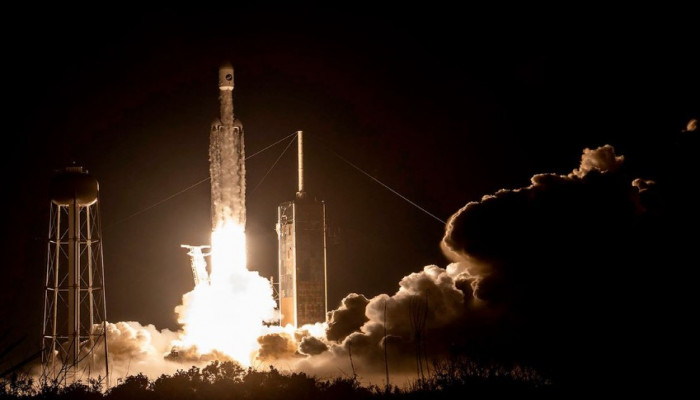
The secretive X-37B robot spaceplane of the US military embarked on its seventh mission, propelled from Florida by a SpaceX Falcon Heavy rocket. This marks the initial launch atop a Falcon Heavy, enabling it to reach a higher orbit than ever before. Similar to past missions, the reusable plane, bearing a resemblance to a mini space shuttle, operates without any crew on board. Its cargo includes classified experiments.
Experiencing a delay of more than two weeks due to technical issues, the Falcon Heavy, constructed from three strapped-together rocket cores, successfully lifted off from NASA’s Kennedy Space Center at Cape Canaveral. Earlier countdowns were thwarted by adverse weather conditions and unspecified technical problems, prompting ground crews to return the spacecraft to its hangar before resuming the flight.
The launch occurred a fortnight following the deployment of China's robot spaceplane, the Shenlong, also recognized as the "Divine Dragon," on its third orbital mission since 2020, introducing a fresh element to the expanding space rivalry between the United States and China.
Details regarding the X-37B mission, managed by the US Space Force within the military's national security space launch program, remain limited, with the Pentagon disclosing scant information.
The specific altitude for the current flight of the spaceplane has not been disclosed by the Pentagon. However, according to a statement from the Air Force Rapid Capabilities Office last month, Mission No. 7 will involve testing "new orbital regimes" and experimenting with upcoming technologies related to space domain awareness.
Additionally, the X-37B is carrying a NASA experiment aimed at investigating the impact of prolonged exposure to space radiation on plant seeds. This study is crucial for understanding how to cultivate crops in space, with significant implications for sustaining astronauts during future extended missions to the moon and Mars.
China's Shenlong, launched on December 14 via a Long March 2F rocket, shares the secretive nature of the X-37B. However, its less powerful launch system, the Long March 2F, is believed to be limited to low-Earth orbit payloads. General B Chance Saltzman anticipates Shenlong's launch to align with the X-37B flight, hinting at competitive dynamics in the space domain between the two nations.
"It's no surprise that the Chinese are extremely interested in our spaceplane. We're equally intrigued by theirs," stated General B Chance Saltzman. He emphasized the significant attention both nations pay to each other's spaceplanes, noting the synchronized timing of their launches as likely intentional, given their status as two of the most closely monitored objects in orbit.
The latest X-37B mission, built by Boeing, has an undisclosed duration but is expected to extend until June 2026 or beyond, following a pattern of progressively longer flights. Resembling NASA's retired shuttles but one-fourth the size (29 feet), the autonomous X-37B requires no astronauts, with a vertical takeoff and horizontal landing design for orbits between 150 and 500 miles high.
Image source: Reuters



 Loading...please wait
Comments