



U.S. and India announce collaboration for joint production of Stryker Armored Vehicles
- In Military & Strategic Affairs
- 04:11 PM, Nov 11, 2023
- Myind Staff
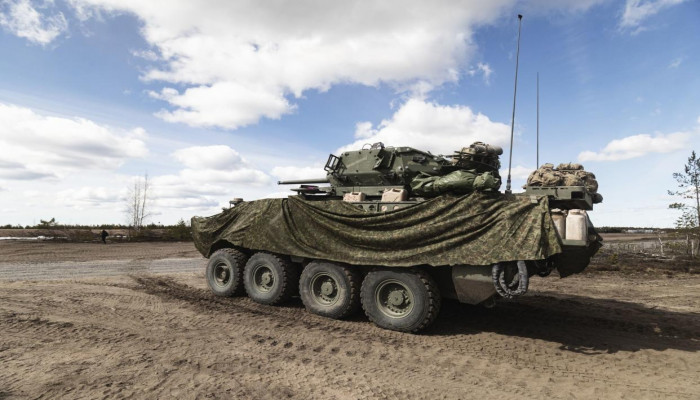
In a strategic move to address the escalating military influence of China in Asia, the United States and India have unveiled plans for a collaborative effort to co-produce Stryker armored vehicles. This joint initiative reflects a shared commitment between the two nations to bolster their military capabilities and enhance regional security. The collaboration is a notable development in the geopolitical landscape, emphasizing the strategic partnership between the U.S. and India in the face of evolving security challenges in the Asia-Pacific region.
A senior U.S. defense official revealed the collaborative initiative during the annual 2+2 ministerial consultations in New Delhi, where foreign and defense ministers from the United States and India convened. The joint statement issued after the meeting highlighted a significant focus on the joint development and production of defense equipment, with particular emphasis on "ground mobility systems." This announcement underscores the commitment of the two nations to strategic cooperation in priority areas, opening the door for further collaborative projects in the realm of defense.
The initiative "will strengthen the shared security of our countries by diversifying supply chains and supporting interoperability between our militaries," stated US Secretary of Defense Lloyd Austin in the Indian capital.
The introduction of these vehicles is a strategic move by India to counter China along their disputed border, concurrently aiming to diminish New Delhi's longstanding reliance on Russian weaponry. This development aligns with a comprehensive, multi-year initiative to fortify U.S.-India relations, encompassing facets such as intelligence sharing, technology transfer, and diplomatic strengthening. The collaboration supports Prime Minister Narendra Modi's agenda to expand India's industrial base.
Speaking on the condition of anonymity, an Indian official disclosed that the majority of these vehicles will be deployed along the India-China border, where tensions persist following a 2020 clash resulting in casualties on both sides. Additionally, some of these vehicles will find deployment along India's border with Pakistan. This deployment strategy reflects a proactive measure to address ongoing geopolitical tensions in the region.
New Delhi is actively seeking the procurement of a substantial number of co-produced vehicles, primarily equipped with anti-tank missile systems, according to an official statement. The Stryker, a versatile wheeled combat vehicle manufactured by General Dynamics Land Systems Inc., is at the forefront of this acquisition. The U.S. Army values the Stryker for its adaptability, boasting over two dozen variants serving diverse purposes such as infantry carriers, reconnaissance platforms, and medical and engineering support.
The U.S. Army has upgraded the Stryker with a 30mm cannon and is considering integrating directed energy weapons for short-range air defense. In a collaborative move, the Biden administration sent Strykers, along with Bradley fighting vehicles and Abrams tanks, to aid Ukraine's defense against Russia. U.S. Ambassador Eric Garcetti highlighted the close U.S.-India partnership, emphasizing its role as a powerful force for good and a deterrent against undesirable actions..
During Prime Minister Modi's June visit to Washington, the U.S. and India pledged to strengthen defense-industry ties, focusing on technologies for intelligence, reconnaissance, and surveillance, as well as aircraft engines and munitions. Steps are being taken to streamline regulations and deepen connections between defense companies. To bolster strategic collaboration, the U.S. and India plan to increase joint exercises across combatant commands and regions, aligning with the evolving geopolitical landscape.
Image source: Times of India
Disclaimer: The opinions expressed within this article are the personal opinions of the author. MyIndMakers is not responsible for the accuracy, completeness, suitability, or validity of any information on this article. All information is provided on an as-is basis. The information, facts or opinions appearing in the article do not reflect the views of MyindMakers and it does not assume any responsibility or liability for the same.



 Loading...please wait
Comments