



Taiwan unveils first indigenously built submarine
- In Reports
- 12:59 PM, Sep 28, 2023
- Myind Staff
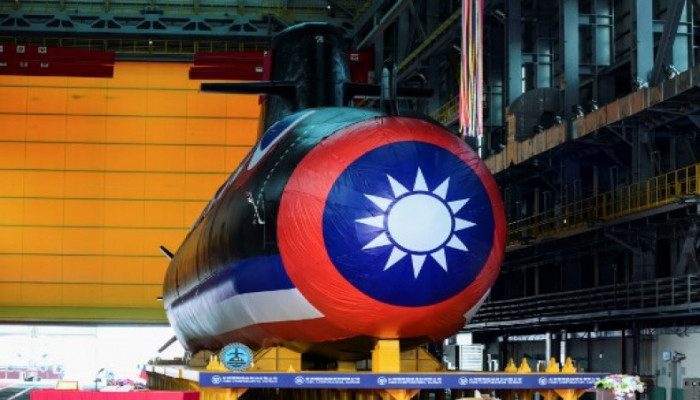
Taiwan has proudly unveiled its first domestically constructed submarine, a significant move aimed at bolstering its defense capabilities amid growing tensions with China. The inaugural prototype, named "Hai Kun," which translates to "mythical sea creature" in Chinese, was introduced at a ceremony in Kaohsiung, a southern port city.
Taiwan's leader, Tsai Ing-wen, hailed the historic occasion, emphasizing the significance of this achievement. She asserted, "History will forever remember this day," while standing before the submarine adorned with Taiwan's flag colors. Tsai expressed the remarkable transformation from considering domestic submarine production as "Mission Impossible" to successfully building a homegrown vessel.
The Hai Kun submarine boasts impressive dimensions, measuring 80 meters in length and possessing a displacement weight ranging from 2,500 to 3,000 tons. It is equipped with combat systems and torpedoes procured from the US defense company Lockheed Martin. The vessel will soon undergo sea trials, with Tsai indicating that it aims to be operational by 2025, although some defense experts suggest it might take longer.
Presently, Taiwan's navy operates only two functioning submarines, both of the Swordfish class, which were acquired from the Netherlands during the 1980s. To bolster its defense capabilities further, Taiwan has increased its military spending substantially, earmarking a record $19 billion for 2024. The country primarily seeks military equipment from its key ally, the United States, but its quest for obtaining a submarine has encountered various challenges.
Tsai Ing-wen, who has been a target of opposition from Beijing due to her steadfast refusal to recognize China's authority over Taiwan, initiated a submarine program in 2016 with the objective of establishing a fleet comprising eight submarines. While Washington initially approved an offer in 2001 to supply eight conventional submarines, the sale never materialized.
During the same period, China has rapidly expanded its naval capabilities, emerging as one of the world's leading naval powers, boasting a fleet that includes nuclear-powered submarines and aircraft carriers.
China's formidable naval fleet includes approximately 60 submarines, as reported by the US Department of Defense, with six of them being nuclear-powered and armed with ballistic missiles. In terms of sheer numbers, this puts Taiwan at a clear disadvantage.
However, strategically deploying its submarines at two critical choke points, namely the Bashi Channel and the Miyako Strait, could significantly disrupt China's naval operations, according to Sifu Ou from Taiwan's Institute for National Defense and Security Research. These choke points are crucial for Taiwan's defense, as they can impede China's ability to navigate freely in the region.
Ben Lewis, an independent expert in the United States who closely monitors the Chinese military's movements near Taiwan, highlighted that Taiwan's new submarine could pose a significant risk to China's amphibious assault and troop transport capabilities. This development underscores the strategic importance of Taiwan's efforts to bolster its naval capabilities amid ongoing regional tensions.
"They have practiced extensively the use of civilian vessels to augment their existing troop delivery platforms, and a submarine could wreak havoc on vessels not designed for naval warfare."
However, Zivon Wang, a military analyst affiliated with the Taipei-based think tank, the Chinese Council of Advanced Policy Studies, pointed out that the newly unveiled submarine still has a substantial journey ahead before it can be considered "combat capable." This assessment suggests that while Taiwan has made significant strides in bolstering its naval defense capabilities, further developments and refinements are necessary to ensure its effectiveness in potential combat scenarios.
"The launch... does not mean that Taiwan will become very powerful right away but it is a crucial element of Taiwan's defence strategy and a part of our efforts to build deterrence capabilities."
Image source: CNN



 Loading...please wait
Comments