



Solar wind ion spectrometre of ISRO's Aditya L1 Mission becomes operational
- In Reports
- 03:37 PM, Dec 02, 2023
- Myind Staff
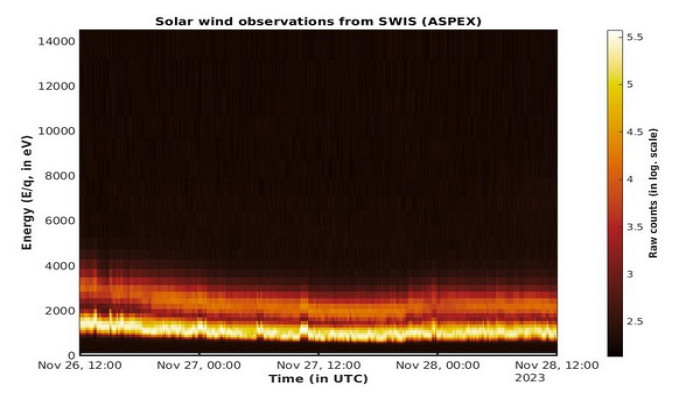
The Indian Space Research Organisation (ISRO) has announced the operational status of the Solar Wind Ion Spectrometer (SWIS), marking a significant development in the Aditya Solar Wind Particle Experiment (ASPEX) of its inaugural solar mission, Aditya L1.
ISRO stated in a post on X "The Solar Wind lon Spectrometer (SWIS), the second instrument in the Aditya Solar Wind Particle Experiment (ASPEX) payload is operational. The histogram illustrates the energy variations in proton and alpha particle counts captured by SWIS over 2-days.”
ISRO has reported that the Aditya Solar Wind Particle Experiment (ASPEX) payload on the Aditya-L1 satellite is functioning as expected. ASPEX includes two advanced instruments, the Solar Wind Ion Spectrometer (SWIS) and STEPS (SupraThermal and Energetic Particle Spectrometer).
The STEPS instrument started operating on September 10, 2023, while the SWIS instrument was activated on November 2, 2023, demonstrating optimal performance, according to the statement. ISRO has confirmed that ASPEX has initiated measurements of solar wind ions.
ISRO additionally mentioned that ASPEX has commenced the measurement of ions in the solar wind. "SWIS, utilizing two sensor units with a remarkable 360° field of view each, operates in planes perpendicular to one another. The instrument has successfully measured solar wind ions, primarily protons and alpha particles," the statement said.
"A sample energy histogram acquired from one of the sensors over two days in November 2023 illustrates variations in proton (H+) and alpha particle (doubly ionized helium, He2+) counts. These variations were recorded with nominal integration time, providing a comprehensive snapshot of solar wind behaviour," it added.
ISRO stated that the precise measurement capabilities of SWIS allow for accurate assessments of solar wind protons and alphas. This contributes significantly to addressing enduring inquiries regarding the properties of solar wind, the associated processes, and their effects on Earth.
The statement highlighted that as scientists analyze the accumulated data, the global scientific community is eagerly anticipating the valuable insights that Aditya-L1's ASPEX is poised to reveal about the mysterious solar wind and its potential implications for our planet.
ISRO's Aditya-L1 spacecraft successfully recorded the impulsive phase of solar flares on October 29, 2023. The onboard HELIOS X-ray spectrometer captured the first high-energy X-ray glimpse of these sudden brightenings of the solar atmosphere. The spectrometer, commissioned on October 27, is currently undergoing fine-tuning and calibration while monitoring the Sun for hard X-ray activities. In early October, the spacecraft performed a brief trajectory correction maneuver (TCM) to rectify its path following the Trans-Lagrangean Point 1 Insertion (TL11) maneuver conducted on September 19.
After the successful Chandrayaan-3 landing, ISRO launched its maiden solar mission, Aditya-L1, on September 2 from Sriharikota. Aditya-L1 won't land on or approach the sun closely, ensuring continuous observation without eclipses. Positioned strategically, it allows real-time study of solar activities' impact on space weather. The data aids in identifying processes leading to solar eruptive events, enhancing understanding of space weather drivers.
Image source: ANI



 Loading...please wait
Comments