



Fortified South China Sea artificial islands project Beijing’s military reach and power, say observers
- In Reports
- 08:11 PM, Nov 07, 2022
- Myind Staff
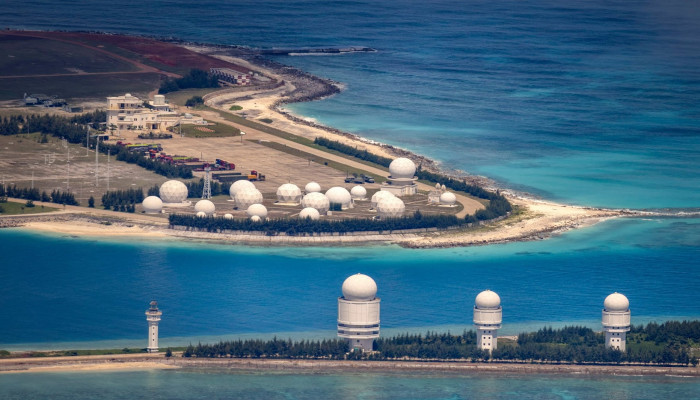
China has further fortified its artificial islands in the South China Sea, with more buildings, radars and aircraft hangars to help project power across the Indo-Pacific, analysts said. Images taken by Philippines-based photographer Ezra Acayan revealed docks, radars, airports, military camps and large aircraft hangars on the seven Chinese artificial islands.
The photos, released by Acayan on social media last week, also showed multi-storey buildings, paved roads, sports fields, and basketball and tennis courts.
A refuelling KJ-500H aircraft was pictured on the taxiway of Fiery Cross Reef. The KJ-500 is China’s third-generation airborne early warning and control aircraft capable of enhancing monitoring in the South China Sea. It is the type of aircraft that has been sent on long-range patrols of the East China Sea and operations in the Taiwan Strait in the past.
One photo on Mischief Reef showed two Type 22 catamaran missile boats, which incorporate stealth features and can carry up to eight YJ-83 subsonic anti-ship missiles. These boats reportedly chased away Philippine news crews who tried to monitor Chinese movement in the region last year, according to Philippine media reports.
The photographer also captured an image of one medium-sized medium-range Y-8 transport aircraft in a hangar on Mischief Reef.
The Y-8, which has been continuously upgraded and produced, is a popular transport aircraft with many variants. The hangar where the Y-8 was stationed can shelter aircraft against hot, humid and high-salinity environments but its construction does not appear strong enough to defend against enemy strikes.
On a corner of Cuarteron Reef, weapon systems similar to the Type H/PJ-26 76mm naval gun and H/PJ-13B defence gun – along with several soldiers - were seen on the top of two towers which provide basic anti-sea and anti-air firepower, and would serve as the last line of defence in a confrontation.
In the same image of Cuarteron Reef, a large radar similar to the SLC-7 three-dimensional early warning radar was seen on the ground. The anti-stealth radar could detect and track multiple targets and was capable of resisting saturation attacks, Chinese state media reported last year.
On Subi Reef, objects similar to trucks were seen being put on the runway, possibly aimed at preventing foreign aircraft from forcibly landing on the island.
Two medical landing pads – with a red cross painted on a white square pad – could be seen on both Mischief Reef and Fiery Cross Reef. However, there was no visible human presence nearby. “Looking at the images, the first thing that strikes me is that there’s not a lot of activity occurring in these bases. Clearly, there are people there, but most of the images suggest a quiet rather than bustling or busy military base. Some of the structures also look in a state of disrepair,” said Malcolm Davis, a senior analyst from the Australian Strategic Policy Institute.
"Having said that – clearly the Chinese have made some progress in terms of making the bases a bit more hospitable,” Davis said, referring to the appearance of more trees on the islands.
“In terms of tactical use, these bases allow the PLA Air Force to forward deploy in a crisis to prepared bases, fully equipped with hardened aircraft shelters and other supporting infrastructure, for operations into the South China Sea.
“I think they also act as unsinkable aircraft carriers for the Chinese air force and navy’s anti-submarine warfare platforms to hunt submarines in the area.”
However, Davis said it was not known how well these bases would survive in a real war. He said they could be used strategically to contest the transit of another state’s aircraft and vessels “potentially under declaration of an air defence identification zone, or more seriously, a blockade”.
Image courtesy: Ezra Acayan/Getty Images



 Loading...please wait
Comments