



Australia and US leaders to address Critical minerals, China, and Pacific infrastructure on agenda
- In Reports
- 11:36 AM, Oct 25, 2023
- Myind Staff
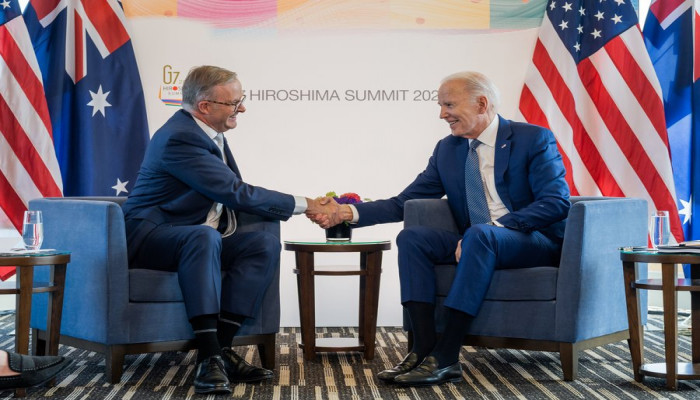
To strengthen their ties, Australia and the United States are set to hold a joint effort to enhance Pacific Islands infrastructure and collaborate on securing critical mineral resources. This was confirmed by a senior official in the Biden administration during Prime Minister Anthony Albanese's visit to Washington, DC.
Albanese's White House schedule commenced in Washington, with a primary focus on expanding Australia's security alliance with the United States to encompass economic and technological collaboration, as relayed by Albanese during his remarks to the press.
The two leaders will elaborate on the specifics of their ongoing cyber security cooperation while also addressing the significant $5 billion investment by Microsoft in Australia, as confirmed by an official from the Biden administration. Multiple announcements, including the infrastructure project, will highlight cooperation between the United States and Australia in the Pacific.
"This is an absolute imperative for both of these leaders," said Mira Rapp-Hooper, special assistant to the president and senior director for East Asia and Oceania on the National Security Council, in an interview with Reuters.
She added, referring to the world's focus on the Middle East, "The prime minister's visit this week is an important reminder that our president, our commander-in-chief, is very much able to keep his steady gaze on the Indo-Pacific and our long-term interest there as he manages the crisis at hand."
"A critical minerals task force aimed at enhancing private investment in Australia's rare earths industry and diminishing global dependence on China will take center stage on Albanese's schedule, as Australia pledges an additional A$2 billion ($1.27 billion) in funding to 'de-risk' private sector engagement."
Albanese said Australia would "help to build supply chains with the United States and support our shared clean energy, manufacturing, and defense ambitions".
"We're in a strong position, as the world's largest supplier of lithium, for example, a significant supply of cobalt, vanadium, copper, nickel. The minerals that will power the globe in the 21st century are things that Australia has significant amounts of," he earlier told reporters in Washington.
This week, no critical minerals agreements with the U.S. Department of Defense are anticipated. Australian analysts have emphasized that the U.S. automotive and defense sectors serve as significant buyers of rare earths, and the establishment of a long-term sales contract could help mitigate investor risk in the development of Australian processing.
Additionally, Albanese's upcoming agenda includes a visit to China, Australia's most prominent trade partner, and the largest purchaser of its iron ore, scheduled for November 4th.
This year, Washington entered into a defense cooperation agreement with Papua New Guinea, situated to the north of Australia. Furthermore, it opened USAID offices in the region, as China secured a security pact with the Solomon Islands. During their meeting, Albanese and Biden will also address the escalating tensions between China and the Philippines in the South China Sea.
During his stay in Washington, he expressed his intention to hold daily meetings with U.S. lawmakers. The primary objective of these meetings is to underscore the necessity of the AUKUS defense technology partnership, which Australia has forged with the United States and Britain. This partnership's core objective is to provide Australia with nuclear-powered submarines and to facilitate the construction of a new submarine class in Australia by the year 2040.
However, this agreement encounters certain challenges within the U.S. Congress and may encounter delays due to U.S. export controls. To address these issues, the Biden administration has presented a supplementary budget request to Congress. This request includes various measures aimed at supporting the United States' commitments under the AUKUS partnership.
Image source: Reuters



 Loading...please wait
Comments