




Algebra Originated in India Part-2
- In Mathematics, Science & Technology
- 09:43 AM, Jul 08, 2021
- Chandrahas Halai
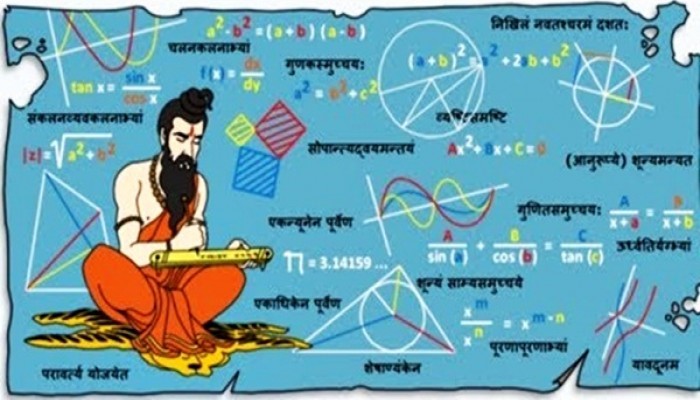
This article is in continuation of earlier article: https://myind.net/Home/viewArticle/algebra-originated-in-india
नवानां मातुलुङ्गानां कपित्थानां सुगन्धिनाम् ।
सप्तानां मूल्यसम्मिश्रं सप्तोत्तरशतं पुनः ॥ १४०
सप्तानां मातुलुङ्गानां कपित्थानां सुगन्धिनाम् ।
नवानां मूल्यसम्मिश्रमेकोत्तरशतं पुनः ॥ १४१
मूल्ये ते वद मे शीघ्रं मातुलुङ्गकपित्थयोः ।
अनयोर्गणक त्वं मे कृत्वा सम्यक् पृथक् पृथक् ॥ १४२
The price of 9 citrons (मातुलुङ्ग) and 7 fragrant wood-apples (बिल्व, कपित्थ) taken together is 107 and the price of 7 citrons and 9 fragrant wood-apples taken together is 101. O mathematician, tell me quickly the price of a citron and of a fragrant wood-apple separately.
The above problem is from the book Ganitasarasangraha written around 850 CE by Digambara Jain monk Mahavira (815 – 877 CE).
The solution of this problem involves linear equations with two unknowns.
Before solving this problem, we will consider problems in which the sum and difference of two unknown quantities are given. They can be represented by equations of the type

To solve this,
First we add equations 1 and 2

Hence, we get

Now to get y, let us subtract equation 2 from 1

Hence, we get

This method was called Sankramana (संक्रमण, concurrence) by ancient Indian mathematicians. It was given in many ancient Indian Mathematics texts including Brahmasphutasiddhanta (composed by Brahmagupta in 628 CE), Ganitasarasangraha, Maha-Sidhhanta (composed by Aryabhatt II in the 10th century), Siddhanta Siromani and Lilavati by Bhaskaracharya and Ganitakaumudi (composed by Narayan Pandita in 1356).
The method of sankramana was explained by this sutra in Lilavati:
योगोऽन्तरेणोनयुतोऽर्धितस्तौ राशी स्मृतौसंक्रमणाख्यमेतत् ॥६१॥
Let us now solve one problem of this type from Lilavati:
ययोर्योगः शतं सैकं वियोगः पंचविंशतिः ।
तौ राशी वद मे वत्स वेत्सि संक्रमणं यदि ॥६२॥
The sum of two numbers is 101 and their difference is 25. If you know the method of sankramana O child, then give me the two numbers.
Solution:
Let the two numbers be x and y.
By the method of Sankramana we have

Now, let us solve our first problem.
Let the price of each citron be x.
And, the price of each wood apple be y.
Then, we have

This class of problems can be represented by the general equations

Multiplying both sides of eqn 1 by a, we get

Multiplying both sides of eqn 2 by b, we get

Subtracting eqn 4 from eqn 3, we get

Multiplying both sides of eqn 1 by b, we get

Multiplying both sides of eqn 2 by a, we get

Subtracting eqn 6 from eqn 5, we get

This method is explained in Ganitasarasangraha in the sutra:
ज्येष्ठघ्रमहाराशेर्जधन्यफलनाडितोनमपनीय ।
फलवर्गशेषभागो ज्येष्ठार्घोऽन्यो गुणस्य विपरीतम् ॥१३९॥
Applying this method to solve our problem, we have

Hence, we have the price of each citron fruit is 8 and that of each wood apple is 5.
Let us solve one more interesting problem from Bhaskaracharya’s Bijaganita.
One friend says to another “Give me a hundred and I shall be twice as rich as you”. The other replies “If you give me a ten, I shall be six times as rich as you.” Find out their respective capitals?
Solution:
Let x and y be the capitals of the two friends.
Then the equations are:

We have

Also

Equating 1 and 2, we have

Hence, we have
y = 170
Substituting this in eqn 1, we get
x = 40
Image Source: myIndiamyglory



 Loading...please wait
Comments